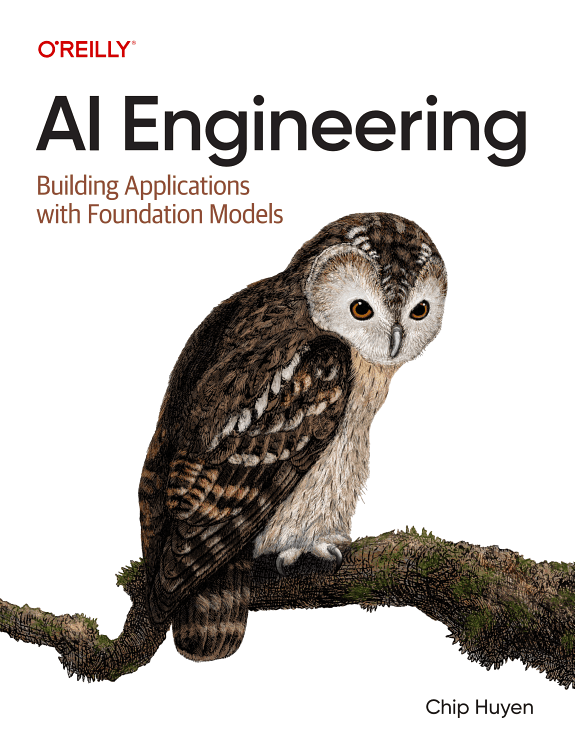
AI Engineering
Building Applications with Foundation Models
Chip Huyen · 2024
The model is the easy part. Evaluation, cost, and retrieval decide whether an AI product holds up.
About the book
AI Engineering is a practical guide to building applications on top of foundation models, the work of shipping with models you do not train yourself. It covers the parts that actually decide whether an AI product holds up: evaluating models, prompt engineering, retrieval augmented generation, finetuning, dataset work, inference optimization, and how to architect and run the whole thing in production. It is written for engineers and technical leads shipping real AI products, not researchers training models from scratch.
About the author
Chip Huyen builds machine learning systems and writes about doing it well. She has worked on ML tooling and infrastructure at NVIDIA, Snorkel AI, and Netflix, co-founded an AI infrastructure startup, and taught machine learning systems design at Stanford. Her earlier book, Designing Machine Learning Systems, became one of the standard texts on putting ML into production.
Key ideas
- Building with foundation models is its own discipline. Most of the work sits around the model, not inside it.
- Evaluation is the hard part. Without a way to measure quality, you cannot tell whether a prompt change, a new model, or a finetune actually helped.
- There is an order of operations: start with prompting, add retrieval when the model lacks context, and finetune only when the first two run out of room.
- Cost and latency are product decisions, not just infrastructure ones. They set the limits of what you can ship.
My take
Reading this while building, which is the right way to take it in. The reassuring part is how much of it I had already hit by feel on the agent work: evaluation is the hard problem, and most of the engineering lives around the model rather than inside it. The order of operations, prompt first, then retrieval, then finetuning, is the bit I wish I had seen written down a year earlier.